01
Put the data in one shape
Map claims, payers, providers, eligibility checks, denials, payments, and work outcomes across acquired companies.
RevCycleOS helps platform operators reconcile claims, payers, denials, payments, and work queues across acquired companies, then route the next step to the right vendor, team, or internal tool.
Public demo uses fake, seeded data only. No PHI, real claims, payer data, or customer data.
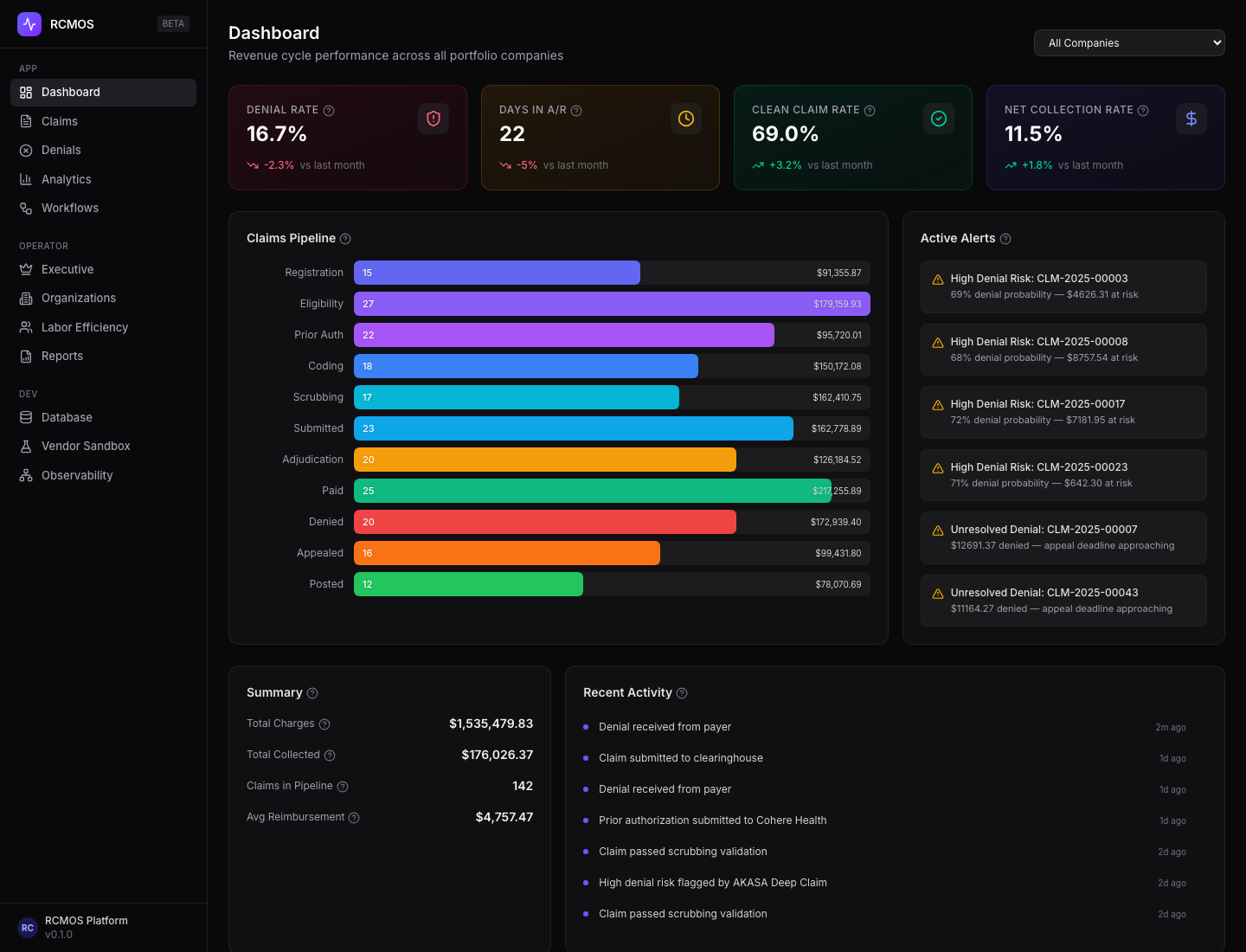
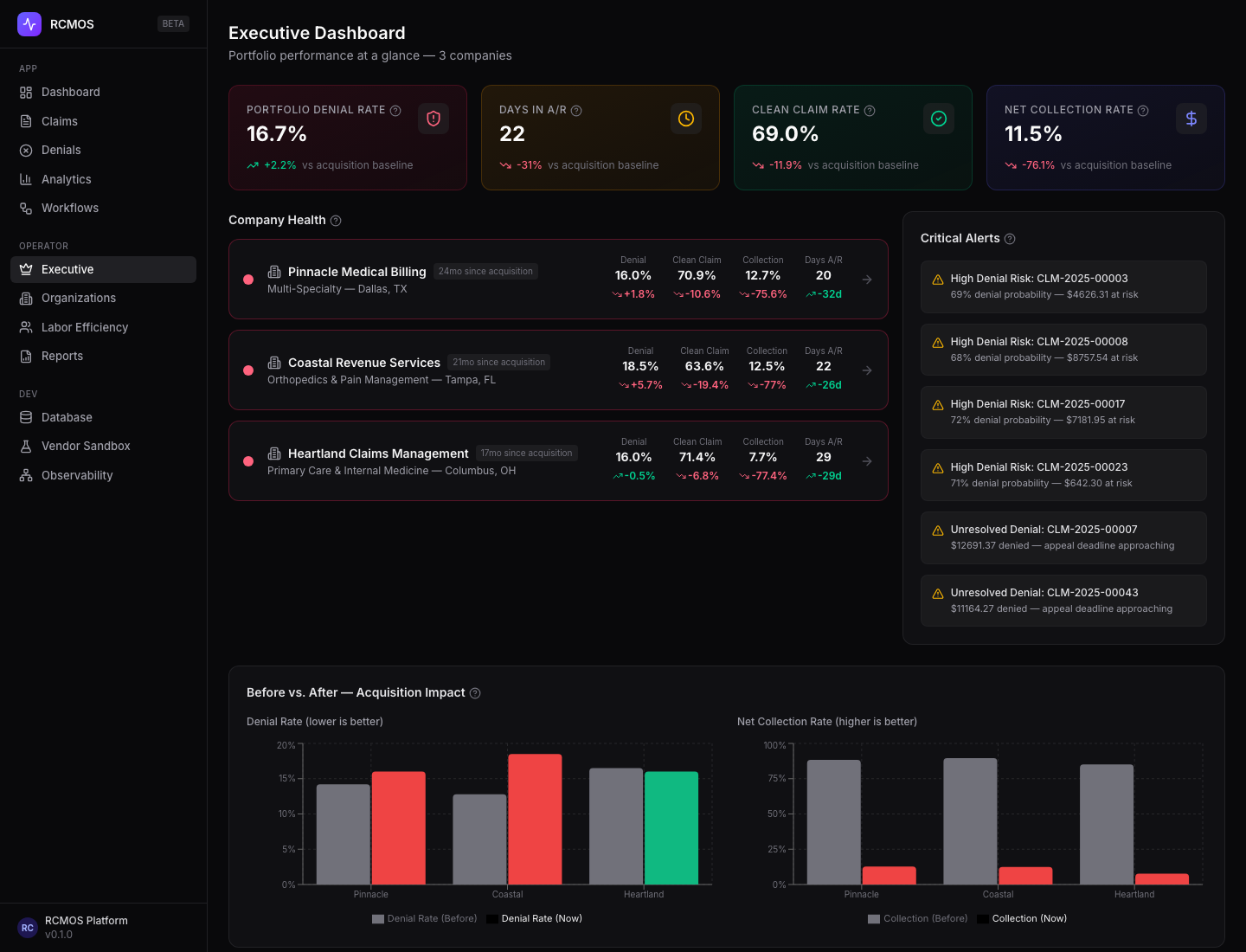
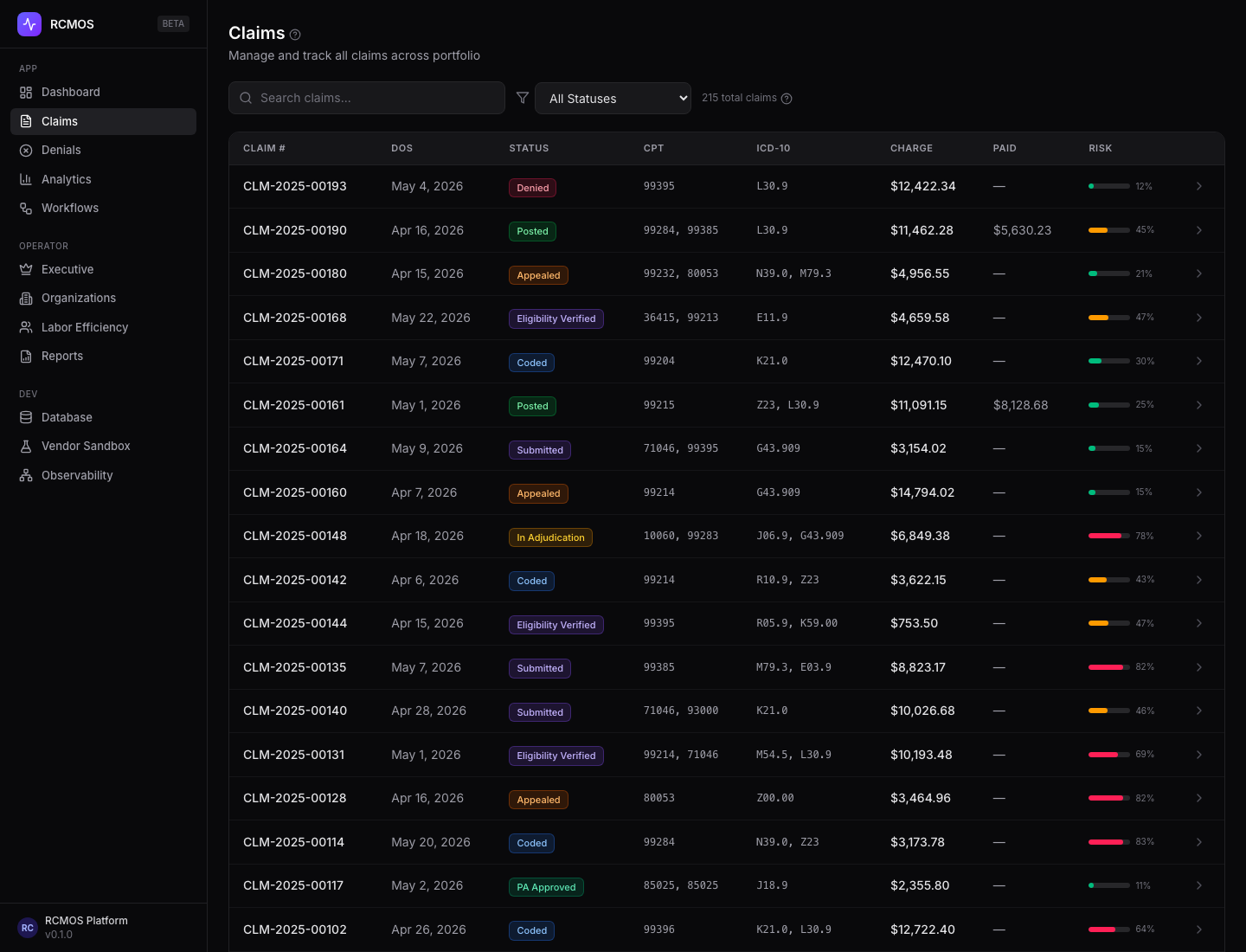
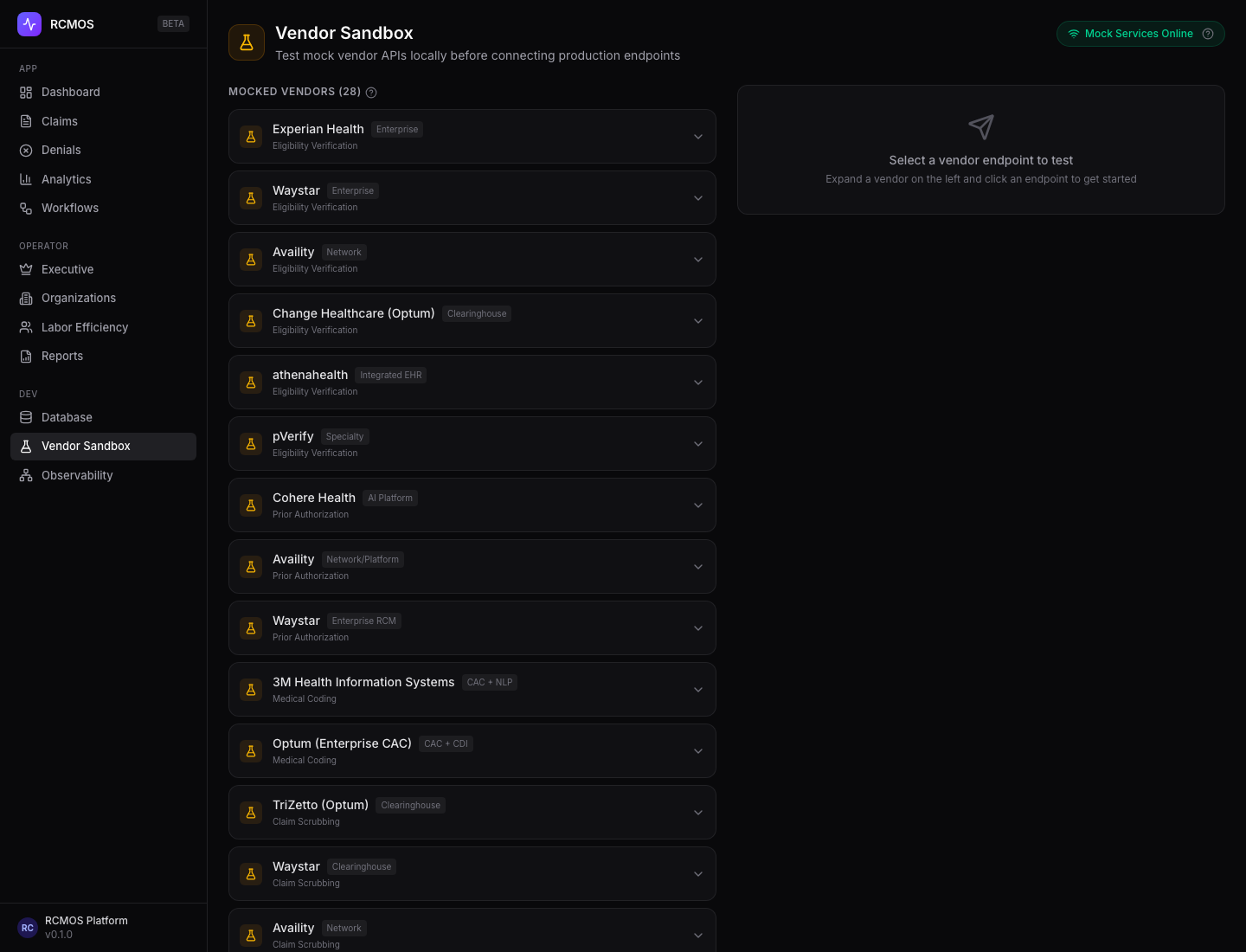
These screenshots use fake, seeded data. They show the current product direction for portfolio metrics, claims worklists, vendor testing, and acquisition follow-up.
Most RCM companies already have plenty: practice systems, clearinghouses, payer portals, spreadsheets, local queues, and tribal knowledge. The hard part is getting a platform-level record you can trust after the acquisition.
Map claims, payers, providers, eligibility checks, denials, payments, and work outcomes across acquired companies.
Send tasks to eligibility, prior auth, coding, scrubbing, appeal, or collections vendors while keeping statuses, timestamps, decisions, and outcomes in RevCycleOS.
Compare denial rate, days in A/R, clean claim rate, staffing load, onboarding progress, and recurring root causes across companies.
RevCycleOS is aimed at the messy integration period when every company has its own tools, data quality issues, payer rules, and workflow assumptions.
Identify the billing systems, vendors, spreadsheets, payer portals, and local queues operators really use.
Bring operational data into a shared structure so the platform can compare companies and choose where to buy, build, integrate, or centralize.
Show leaders and workflow owners where claims slow down, where denials cluster, and which automation paths deserve more investment.
Practical notes, not a brochure. First guides cover acquisition cleanup, vendor choices, and the metrics RCM operators actually ask for.
How to decide which revenue cycle workflows belong with vendors, which belong in-house, and which need better data capture.
Read guideA practical first-90-day checklist for cleaning up source systems, baselines, and work ownership before adding automation.
Read guideA plain-English definition for PE-backed RCM platforms trying to run multiple billing operations after acquisition.
Read guideJoin the early list for product notes, private demo conversations, and practical guides for PE-backed RCM operators.
No spam. Email-only waitlist powered by Loops. Public demo data is fake only.